
Geometry Formula Sheet PDF: An Overview
Geometry formula sheets, often in PDF format, consolidate essential 2D and 3D shape calculations, aiding students and professionals in quick reference and problem-solving.
Geometry formulas are fundamental tools for calculating properties of shapes – lengths, areas, volumes, and angles. These formulas aren’t just abstract rules; they represent relationships discovered through mathematical reasoning and are crucial for applications in fields like architecture, engineering, and design. A comprehensive geometry formula sheet PDF serves as a readily available resource, compiling these essential equations for quick access.
Understanding these formulas requires grasping the definitions of geometric objects – points, lines, planes, and various 2D and 3D figures. The sheet typically categorizes formulas by shape, including rectangles, triangles, circles, cubes, and spheres, providing a structured approach to learning and problem-solving. Mastering these formulas empowers individuals to analyze and interpret spatial relationships effectively.
Why Use a Geometry Formula Sheet?
A geometry formula sheet PDF streamlines problem-solving by providing a centralized repository of essential equations, eliminating the need to memorize numerous formulas. This is particularly beneficial during exams or when tackling complex projects where quick recall is vital. These sheets enhance efficiency, reducing errors and saving valuable time.
Furthermore, they serve as excellent learning aids, reinforcing understanding through repeated exposure and application. Students can use them to check their work, identify areas for improvement, and build confidence; Printable versions offer portability, allowing access anywhere, anytime. Ultimately, a well-organized formula sheet empowers users to focus on applying concepts rather than struggling with memorization.
Two-Dimensional Geometry Formulas
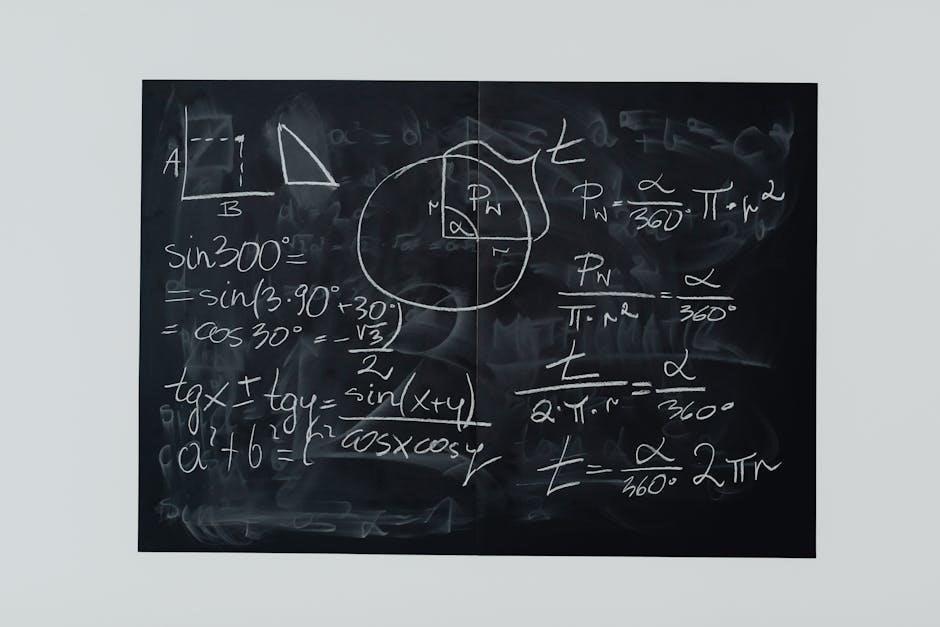
Geometry formula sheets commonly include calculations for rectangles, squares, triangles, circles, and parallelograms, focusing on perimeter, area, and key dimensional properties.
Rectangle and Square Formulas
Rectangle and square formulas are foundational in two-dimensional geometry, frequently appearing on geometry formula sheets. For rectangles, the perimeter (P) is calculated as 2ℓ + 2w, where ℓ represents length and w represents width. The area (A) is simply length multiplied by width (ℓw).
Squares, being special cases of rectangles where all sides are equal, utilize similar formulas. The perimeter of a square is 4s (where ‘s’ is the side length), and the area is s². These formulas are essential for calculating dimensions and spatial relationships within rectangular and square shapes. A solid understanding of these basics is crucial for tackling more complex geometric problems, making them a staple on any comprehensive geometry reference sheet.
Perimeter of Rectangle/Square
The perimeter, representing the total distance around a two-dimensional shape, is calculated differently for rectangles and squares, though related. A rectangle’s perimeter (P) is found by summing all sides: P = 2ℓ + 2w, where ℓ is the length and w is the width. Essentially, it’s twice the length plus twice the width.
For a square, where all sides are equal (denoted as ‘s’), the perimeter simplifies to P = 4s. This is because all four sides have the same length. These formulas are fundamental and consistently included on geometry formula sheets, providing a quick reference for determining the boundary length of these common shapes. Mastering these is key to solving various geometric problems.
Area of Rectangle/Square
Calculating the area – the space enclosed within a two-dimensional shape – differs for rectangles and squares. A rectangle’s area (A) is determined by multiplying its length (ℓ) by its width (w): A = ℓw. This represents the number of unit squares that can fit inside the rectangle.
For a square, since all sides are equal (s), the area simplifies to A = s². This means the area is the side length multiplied by itself. These area formulas are consistently featured on geometry formula sheets, offering a straightforward method for calculating the surface covered by these shapes. Understanding these concepts is crucial for various mathematical applications.
Triangle Formulas
Geometry formula sheets dedicate significant space to triangles, given their versatility. The perimeter (P) of any triangle is simply the sum of all three sides: P = a + b + c, where a, b, and c represent the lengths of each side. However, calculating the area requires more nuance.
The most common formula utilizes the base (b) and height (h) of the triangle: A = 1/2bh. The height must be perpendicular to the base. Different triangle types (equilateral, isosceles, scalene) might necessitate alternative area calculations, but the base-height formula remains fundamental and is prominently displayed on most PDF formula guides.
Perimeter of a Triangle
A geometry formula sheet clearly defines the perimeter of a triangle as the total distance around its exterior. This is calculated by summing the lengths of all three sides. Representing the sides as ‘a’, ‘b’, and ‘c’, the formula is expressed simply as P = a + b + c.
This fundamental concept is consistently presented in PDF resources, often accompanied by a visual diagram for clarity. Understanding the perimeter is crucial for various applications, including fencing, landscaping, and basic geometric problem-solving. The simplicity of this formula makes it a cornerstone of introductory geometry studies.
Area of a Triangle
A comprehensive geometry formula sheet details the area of a triangle as half the product of its base and height. The base (b) is any side of the triangle, and the height (h) is the perpendicular distance from the base to the opposite vertex. The formula is universally represented as A = 1/2 * b * h.
PDF versions of these sheets frequently illustrate this concept with diagrams, emphasizing the importance of the perpendicular height. Mastering this formula is essential for calculating land areas, surface areas, and solving more complex geometric problems. It’s a foundational element in understanding two-dimensional shapes.
Circle Formulas
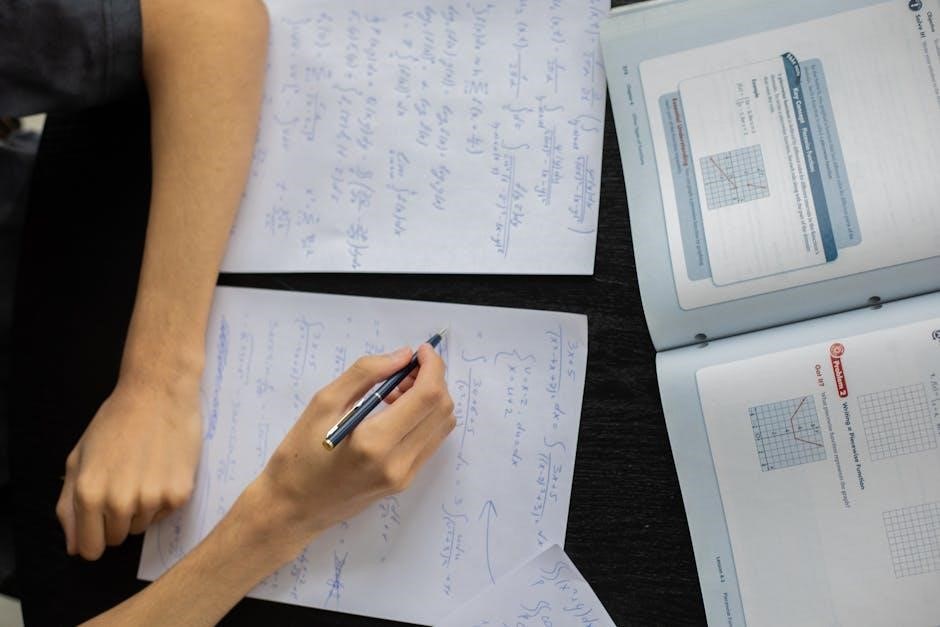
Geometry formula sheets, particularly those available as PDFs, prominently feature formulas related to circles. These include calculating the circumference – the distance around the circle – using the formula C = 2πr, where ‘r’ represents the radius. The area of a circle, representing the space enclosed within, is calculated as A = πr2.
These sheets often provide visual aids alongside the formulas, clarifying the relationship between radius, diameter, and circumference. Understanding these formulas is crucial for various applications, from engineering to architecture, and forms a core component of geometric understanding.
Circumference of a Circle
A geometry formula sheet PDF will invariably include the circumference of a circle formula: C = 2πr. This calculates the distance around the circle, utilizing ‘π’ (pi – approximately 3.14159) and ‘r’, representing the circle’s radius. Alternatively, knowing the diameter (d), the circumference can be found using C = πd, as the diameter is twice the radius.
These sheets often emphasize the units of measurement, ensuring consistency in calculations. Mastering this formula is fundamental for solving problems involving circular shapes, frequently encountered in both theoretical mathematics and practical applications like wheel design or circular gardens.
Area of a Circle
Any comprehensive geometry formula sheet PDF will prominently feature the area of a circle formula: A = πr². This equation determines the space enclosed within the circle’s boundary, using ‘π’ (pi, approximately 3.14159) and ‘r’, denoting the radius of the circle. Understanding this formula is crucial for calculating areas of circular objects.
The sheets often provide visual aids alongside the formula, reinforcing the concept. Practical applications are numerous, ranging from calculating the amount of material needed to cover a circular surface to determining the capacity of a circular tank. Accurate application of this formula is essential for precise results.

Parallelogram Formulas
A useful geometry formula sheet PDF will include formulas for parallelograms, essential for calculating their perimeter and area. The perimeter, representing the total length of all sides, is calculated as P = 2a + 2b, where ‘a’ and ‘b’ are the lengths of adjacent sides. This is due to opposite sides being equal in length.
Calculating the area requires a different approach: A = bh, where ‘b’ represents the base length and ‘h’ is the perpendicular height. These formulas are vital for solving problems involving land surveying, architectural designs, and various engineering applications. Visual diagrams often accompany these formulas for clarity.
Perimeter of a Parallelogram
A comprehensive geometry formula sheet PDF clearly defines the perimeter of a parallelogram as the sum of all its sides. Because opposite sides of a parallelogram are equal in length, the formula simplifies to P = 2a + 2b, where ‘a’ and ‘b’ represent the lengths of adjacent sides.
Understanding this formula is crucial for practical applications like fencing a parallelogram-shaped garden or determining the amount of material needed for borders. The formula’s simplicity makes it easily applicable, and a good formula sheet will often include a visual representation of a parallelogram with labeled sides to aid comprehension.
Area of a Parallelogram
A reliable geometry formula sheet PDF will prominently feature the area of a parallelogram calculation: Area = base × height. It’s vital to remember that the ‘height’ is the perpendicular distance between the base and its opposite side, not the length of the slanted side.
This formula is fundamental for calculating land areas, floor spaces, and various design applications. Visual aids within the PDF often demonstrate how to correctly identify the base and corresponding height. Mastering this concept, alongside understanding the perimeter, provides a complete understanding of parallelogram properties and measurements.
Three-Dimensional Geometry Formulas
Geometry formula sheets in PDF format extend to 3D shapes, providing formulas for volume and surface area of cubes, spheres, and other solids.

Cube Formulas
A cube, a fundamental three-dimensional shape, requires specific formulas for calculating its volume and surface area, readily available on comprehensive geometry formula sheets, often in PDF format. Determining the volume – the amount of space enclosed within the cube – is achieved by cubing the length of one of its sides (s³).
Conversely, calculating the surface area – the total area of all six faces – involves finding the area of one face (s²) and multiplying it by six (6s²). These formulas are crucial for various applications, from calculating the capacity of containers to determining material requirements for construction. PDF resources streamline access to these essential calculations, offering a convenient and organized reference for students and professionals alike.
Volume of a Cube
The volume of a cube, a key calculation found on any good geometry formula sheet – frequently available as a PDF – represents the three-dimensional space it occupies. It’s determined by multiplying the cube’s side length by itself three times. This is mathematically expressed as V = s³, where ‘V’ denotes volume and ‘s’ represents the length of a single side.
Understanding this formula is vital for practical applications, such as calculating the capacity of cubic containers or determining the amount of material needed to construct a cube-shaped object. PDF guides often include illustrative examples, reinforcing comprehension and enabling efficient problem-solving. Mastering this simple yet powerful formula unlocks a fundamental aspect of spatial reasoning.
Surface Area of a Cube
A comprehensive geometry formula sheet, often conveniently accessed as a PDF, will invariably include the formula for calculating a cube’s surface area. This represents the total area covering all six faces of the cube. Since all faces are identical squares, the calculation is straightforward: Surface Area = 6s², where ‘s’ signifies the length of one side of the cube.
This formula is crucial in scenarios requiring material estimation – for instance, determining the amount of paint needed to coat a cube-shaped object or calculating the material required to construct its exterior. PDF resources frequently provide diagrams and worked examples, enhancing understanding and practical application of this essential geometric principle.
Sphere Formulas
A readily available geometry formula sheet, typically in PDF format, provides essential formulas for spheres, fundamental in various mathematical and scientific applications. Two key formulas are consistently included: the volume and the surface area. The volume of a sphere is calculated using the formula V = (4/3)πr³, where ‘r’ represents the sphere’s radius.
Conversely, the surface area, representing the total area covering the sphere’s outer surface, is determined by the formula A = 4πr². These formulas are vital in fields like physics, engineering, and computer graphics. PDF guides often supplement these with illustrative diagrams and step-by-step examples for clarity.
Volume of a Sphere
A comprehensive geometry formula sheet, often available as a PDF, clearly states the formula for calculating a sphere’s volume. This crucial measurement, representing the three-dimensional space enclosed within the sphere, is determined using the equation: V = (4/3)πr³. Here, ‘V’ denotes volume, ‘π’ (pi) is a mathematical constant approximately equal to 3.14159, and ‘r’ signifies the sphere’s radius.
Understanding this formula is essential for solving problems in various fields, including physics and engineering. PDF resources frequently include worked examples demonstrating its application, ensuring clarity and ease of use for students and professionals alike. Accurate volume calculation relies on precise radius measurement.
Surface Area of a Sphere
A readily accessible geometry formula sheet, commonly found as a PDF download, provides the formula to determine a sphere’s total surface area. This represents the total area covering the sphere’s outer surface and is calculated using the equation: SA = 4πr². Here, ‘SA’ denotes surface area, ‘π’ (pi) is approximately 3.14159, and ‘r’ represents the sphere’s radius.
These PDF guides often include illustrative examples, aiding comprehension and practical application. Mastering this formula is vital in fields like material science and packaging, where calculating surface coverage is crucial. Accurate radius measurement is paramount for precise surface area determination.

Linear Pair Property

A comprehensive geometry formula sheet PDF will often include angle relationships, notably the linear pair property. This property defines angles formed when a ray’s endpoint lies on a line, creating adjacent angles. These angles, constituting a linear pair, are always supplementary – meaning their measures sum to 180 degrees.
Understanding this property is fundamental for solving geometric proofs and problems involving angle measurements. PDF resources frequently illustrate this concept with diagrams, enhancing clarity. Applying the linear pair property allows for the determination of unknown angles when one angle’s measure is known, simplifying complex geometric calculations.