
Organic nomenclature is crucial; resources like Salisbury University’s guides and Chemistry Steps offer practice. Workbooks with solved problems, including naming and structure drawing, are readily available as PDFs.
Importance of IUPAC Nomenclature
IUPAC nomenclature provides a systematic and unambiguous method for naming organic compounds, vital for clear communication within the scientific community. Utilizing standardized naming conventions, like those detailed in practice problem sets available as PDFs, eliminates confusion arising from common or trivial names.
Consistent naming is essential for accurately referencing compounds in research, publications, and databases. Resources such as those from Boston University and MCAT study guides emphasize mastering this system. Practice with naming and drawing structures – often found in PDF workbooks – reinforces understanding. Correctly applying IUPAC rules ensures everyone understands the exact molecular structure being discussed, preventing errors and fostering collaboration. Proficiency, gained through dedicated practice, is fundamental for success in organic chemistry and related fields.
Historical Development of Nomenclature Systems
Historically, organic compound naming relied on trivial names – often derived from sources or observed properties – leading to inconsistencies. As organic chemistry advanced, particularly with A.M. Butlerov’s structural theory, the need for a systematic approach became apparent. Early attempts lacked the precision of modern systems.
The International Union of Pure and Applied Chemistry (IUPAC) gradually developed standardized rules, evolving over decades to accommodate increasingly complex molecules. Today, IUPAC nomenclature is the globally accepted standard. Numerous PDF practice resources, like those found in organic chemistry workbooks, help students navigate this system. Mastering these rules, through consistent practice with naming and structure-drawing exercises, builds upon this historical progression towards clarity and universal understanding.

Basic Nomenclature Rules
IUPAC rules prioritize identifying the parent chain and functional groups, then numbering for substituent location; practice PDFs reinforce these fundamentals for accurate naming.
Naming Alkanes
Alkane nomenclature forms the foundation of organic naming, beginning with identifying the longest continuous carbon chain – this determines the parent alkane name (methane, ethane, propane, etc.).
Practice is key! Numerous PDF workbooks, like those from MCAT study guides and Chemistry Steps, provide extensive problems focusing on both straight-chain and branched-chain alkanes.
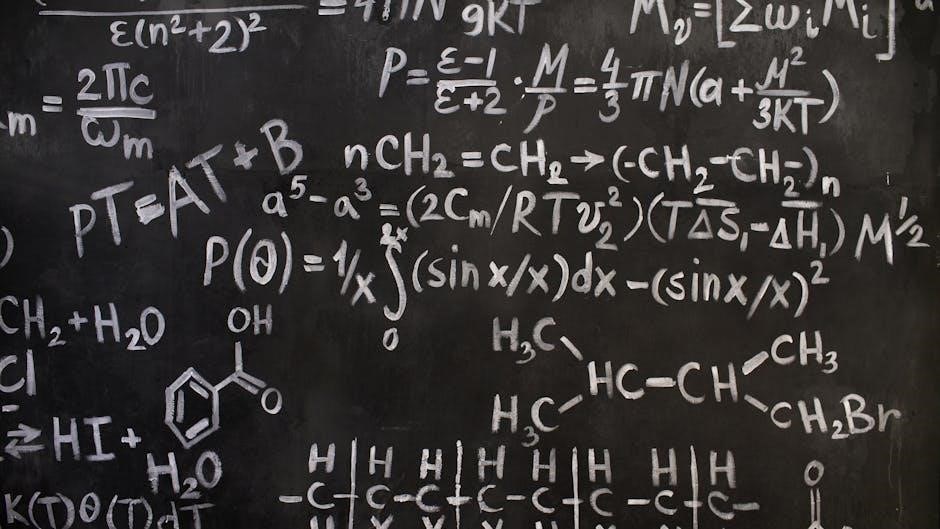
For branched alkanes, locate and name each substituent (methyl, ethyl, propyl) and indicate their position on the main chain with numbers. Resources emphasize the prefix-parent-suffix system.
These practice sets often include answer keys, allowing self-assessment and reinforcing the correct application of IUPAC rules. Mastering alkane naming is essential before tackling more complex structures.
Consistent practice with these PDF resources builds confidence and accuracy in naming these fundamental organic compounds.
Straight-Chain Alkanes
Straight-chain alkanes are the simplest hydrocarbons, and their naming is straightforward. The number of carbon atoms dictates the name: methane (1C), ethane (2C), propane (3C), butane (4C), and so on.
Practice problems, readily available in PDF format from sources like MCAT prep materials and Chemistry Steps, focus on recognizing these basic structures and their corresponding names.
These exercises often involve matching the formula to the name or vice versa, solidifying the connection between structure and nomenclature.
Workbooks provide ample examples, with solutions allowing for self-checking and error analysis. Mastering these foundational names is crucial before progressing to branched alkanes.
Consistent practice with these PDF resources ensures a firm grasp of straight-chain alkane nomenclature.
Branched-Chain Alkanes
Branched-chain alkanes present a greater challenge in nomenclature, requiring identification of the longest continuous carbon chain (the parent chain) and naming of substituent groups (alkyl branches).
Practice problems, often found in PDF workbooks and online quizzes – like those from Salisbury University’s library guides – emphasize numbering the parent chain to give substituents the lowest possible numbers.
These exercises frequently involve naming complex structures or drawing structures from given IUPAC names.
Resources such as MCAT study guides offer detailed solutions, demonstrating the systematic approach to assigning names.
Mastering this requires diligent practice with varied examples, ensuring correct identification of parent chains and substituents, and proper numbering conventions. Consistent use of PDF practice sets is key.
Naming Alkenes and Alkynes
Naming alkenes and alkynes builds upon alkane nomenclature, with the addition of suffixes indicating the presence and position of double (-ene) or triple (-yne) bonds.
Practice problems, commonly available as PDFs from sources like MCAT study guides and Chemistry Steps, focus on correctly identifying the parent chain containing the multiple bond and numbering it to give the lowest possible number to the first carbon of the functional group.
These exercises also involve naming compounds with both branching and unsaturation.
Salisbury University’s resources provide extra practice, while workbooks offer solutions to verify understanding.
Successfully tackling these requires mastering the priority rules for numbering and accurately representing the position of the multiple bond in the IUPAC name. Consistent PDF practice is vital.
Identifying Parent Chain and Substituents
Identifying the parent chain – the longest continuous carbon chain – is fundamental to organic nomenclature. Practice problems, often found in PDF format from resources like MCAT prep materials and Chemistry Steps, emphasize this skill.
These exercises require discerning the main chain even with branching or functional groups present; Simultaneously, students must correctly identify substituents – groups attached to the parent chain – and name them appropriately (alkyl, halo, etc.).
Salisbury University’s library guides offer supplementary practice.
Workbooks containing solved examples are invaluable for verifying answers and understanding common pitfalls. Mastering this step is crucial before tackling more complex naming scenarios, and consistent PDF practice is key.
Numbering the Carbon Chain
Correctly numbering the carbon chain is vital for accurately naming organic compounds, ensuring substituents receive the lowest possible numbers. Practice problems, frequently available as PDFs from sources like MCAT study guides and Chemistry Steps, focus on this skill.
These exercises often present structures where numbering can be approached from either end; students must choose the direction yielding the lowest locant numbers for all substituents. Resources from Salisbury University’s library guides provide additional practice.
Workbooks with solutions demonstrate the correct numbering schemes and explain the reasoning behind them. Consistent practice with PDF worksheets builds proficiency and minimizes errors.

Nomenclature of Functional Groups
Functional group naming requires specific rules; practice problems in PDF format, covering alcohols, aldehydes, ketones, and more, are widely available for effective learning.
Alcohols and Phenols
Naming alcohols involves identifying the longest carbon chain containing the hydroxyl (-OH) group, changing the -e ending of the parent alkane to -ol, and numbering to prioritize the -OH. Phenols, with the -OH group directly attached to a benzene ring, are named as derivatives of phenol.
Numerous organic nomenclature practice problems, often available as PDFs, focus specifically on alcohols and phenols. These resources present structures requiring IUPAC naming and names demanding structural diagrams. Solutions are typically included, enabling self-assessment and reinforcing understanding of the naming conventions. Mastering these requires consistent practice with varied examples, including branched chains and multiple substituents. Resources from MCAT prep and general organic chemistry study guides are particularly helpful.
Ethers
Ethers are characterized by an oxygen atom bonded to two alkyl or aryl groups (R-O-R’). IUPAC naming involves identifying the two groups attached to the oxygen, listing them alphabetically, and adding the word “ether.” Complex ethers may require identifying the larger alkyl group as the parent chain.
Organic nomenclature practice problems, frequently found as PDFs, dedicate sections to ether naming. These exercises present structures to name and names to draw, testing comprehension of the ether functional group. Solutions are vital for verifying answers and understanding common errors. Resources like MCAT study guides and general organic chemistry workbooks provide ample practice. Consistent engagement with these problems builds proficiency in systematically naming and recognizing ether compounds, including cyclic ethers.
Aldehydes and Ketones
Aldehydes contain a carbonyl group (C=O) bonded to at least one hydrogen atom, while ketones have a carbonyl group bonded to two alkyl or aryl groups. IUPAC naming involves identifying the longest carbon chain containing the carbonyl, changing the “-ane” ending to “-al” for aldehydes and “-one” for ketones.
Organic nomenclature practice problems, often available as PDFs, heavily feature aldehydes and ketones. These exercises challenge students to name structures and draw structures from given IUPAC names. Solutions are crucial for self-assessment. Many resources, including MCAT prep materials and organic chemistry workbooks, offer extensive practice. Mastering these compounds requires understanding positional numbering and substituent identification, skills honed through consistent problem-solving.

Complex Nomenclature Scenarios
Practice problems in PDF format address cycloalkanes, multiple functional groups, and halogenated compounds; mastering these requires diligent study and solution checking.
Cycloalkanes and Cyclic Alkenes
Naming cycloalkanes and cyclic alkenes presents unique challenges within organic nomenclature. Practice PDFs often include structures requiring identification of the ring system as the parent chain. Substituents are named as with alkanes, but the ‘cyclo-‘ prefix is essential.
For cyclic alkenes, the double bond’s position must be indicated with a number, prioritizing the lowest possible number. Resources like those from Boston University emphasize the prefix-parent-suffix rule.
Practice problems frequently involve assigning IUPAC names to complex cyclic structures and conversely, drawing structures from given names. Mastering these requires consistent application of the rules and careful attention to detail, alongside checking provided solutions.
Compounds with Multiple Functional Groups
Nomenclature becomes significantly more complex when molecules contain multiple functional groups. Practice problems in PDF format often focus on establishing a priority order for these groups – carboxylic acids generally take precedence over alcohols, for example.
The principal functional group dictates the suffix, while others become substituents indicated by prefixes. Resources emphasize careful numbering to give the principal group the lowest possible number.
Consistent practice, utilizing solved examples, is crucial for mastering this aspect of organic chemistry; Workbooks from sources like MCAT study guides provide extensive exercises, aiding in the accurate naming and structural representation of these challenging compounds.
Naming Halogenated Organic Compounds
Halogenated organic compounds are named by treating the halogen substituent (fluoro, chloro, bromo, iodo) as a prefix to the parent hydrocarbon name. Practice problems, often found in PDF format, emphasize correctly identifying and locating these halogens.
Multiple halogen substituents are indicated with prefixes like di-, tri-, and tetra-, along with the corresponding halogen name and their position numbers. When multiple halogens are present, they are listed alphabetically.

Resources like those from Salisbury University and MCAT prep materials provide exercises to solidify understanding. Mastering halogen nomenclature requires consistent practice with varied structures and detailed solution sets.

Isomerism and Nomenclature
Isomerism impacts naming; practice problems in PDF format help distinguish structural and stereoisomers (cis/trans, E/Z). Accurate naming requires understanding these distinctions.
Structural Isomers
Structural isomers, also known as constitutional isomers, share the same molecular formula but differ in their bonding arrangement. Mastering their identification is vital in organic nomenclature. Practice resources, often available as PDFs, present compounds requiring you to draw all possible structural isomers for a given formula.
These practice problems challenge you to systematically vary the carbon chain length, branching, and functional group positions. Solutions demonstrate the correct IUPAC names for each isomer, reinforcing the naming rules. Resources from sites like Chemistry Steps and university library guides provide extensive sets of these problems. Successfully completing these exercises builds a strong foundation for predicting and naming complex organic molecules, and understanding how different arrangements impact chemical properties.
Stereoisomers (Cis/Trans, E/Z)
Stereoisomers possess the same connectivity but differ in the spatial arrangement of atoms. Cis/trans and E/Z notations specifically describe isomers around double bonds or rings. Organic nomenclature practice problems, often found in PDF format, focus on assigning these configurations correctly.
These exercises require analyzing the substituents around the double bond or ring, applying priority rules (Cahn-Ingold-Prelog) to determine E/Z designations. Resources emphasize visualizing the 3D structure to accurately identify cis/trans arrangements. Solutions provide detailed explanations of the priority assignments and resulting nomenclature. Mastering this skill is crucial for understanding the impact of stereochemistry on a molecule’s properties and reactivity, and is frequently tested in organic chemistry coursework.

Practice Problems: Naming Compounds
Practice is key! Numerous PDF resources, like those from Chemistry Steps, offer extensive organic nomenclature practice problems with detailed answers for self-assessment.
Practice Set 1: Alkanes and Alkenes
Sharpen your skills with focused practice on alkanes and alkenes! Several PDF workbooks provide comprehensive sets of nomenclature practice problems specifically designed for these foundational hydrocarbons. These resources typically include a diverse range of structures – straight-chain, branched-chain, and those with varying alkene positions.
Expect to encounter problems requiring you to assign IUPAC names to given structures, and conversely, to draw structures based on provided names. Crucially, many of these PDFs include detailed answer keys, allowing for immediate self-assessment and identification of areas needing improvement. Look for sets containing 50+ compounds for thorough practice, as offered by Chemistry Steps, to build confidence and mastery.
Practice Set 2: Alcohols, Aldehydes, and Ketones
Mastering the nomenclature of functional groups requires dedicated practice. Numerous PDF resources offer targeted practice problems focusing on alcohols, aldehydes, and ketones. These sets often present structures with varying chain lengths and substituent patterns, challenging your ability to correctly identify the parent chain and functional group priority.
Expect exercises involving naming compounds with multiple substituents, as well as drawing structures from IUPAC names. The best PDF workbooks provide comprehensive answer keys, enabling self-checking and reinforcing correct naming conventions. Resources like MCAT study guides often include these problem sets, covering branched-chain examples and diverse functional group combinations for robust preparation.

Practice Problems: Drawing Structures from Names
PDF resources provide sets of IUPAC names; students then draw corresponding structures. These exercises, like those from Chemistry Steps, build crucial skillsets.
Practice Set 3: Simple Structures
This practice set focuses on building a foundational understanding of organic nomenclature by translating names into structures. Utilizing PDF resources, students encounter straightforward alkanes, alkenes, and alkynes. Examples include compounds like 2-methylpropane, 1-butene, and ethyne.
The goal is to accurately represent the carbon skeleton and functional groups based on the IUPAC name. These problems emphasize correct chain length identification, substituent placement, and appropriate bond representation. Solutions are typically provided within the PDF workbooks, allowing for self-assessment and error correction. Mastering these simple structures is essential before tackling more complex molecules. Resources from sites like Chemistry Steps offer comprehensive practice sets.
Practice Set 4: Complex Structures
This advanced practice set challenges students with intricate organic molecules, demanding a thorough grasp of IUPAC nomenclature. PDF resources present compounds featuring multiple functional groups, cyclic structures, and branched chains. Examples include molecules with alcohol, ketone, and alkene functionalities combined.
Successfully completing these problems requires careful attention to priority rules for naming, accurate identification of the parent chain, and precise numbering. Students translate names into structures and vice-versa, reinforcing their understanding. Detailed solutions within the PDF guides aid in identifying and correcting errors. Mastering these complex structures demonstrates proficiency in organic nomenclature, preparing students for advanced chemistry coursework.

Resources for Further Practice
Numerous online quizzes and PDF workbooks provide extensive practice in organic nomenclature. These resources include solved problems, aiding comprehension and skill development.
Online Nomenclature Quizzes
Numerous websites offer interactive online quizzes designed to reinforce your understanding of organic nomenclature. These quizzes frequently present structures and ask you to provide the IUPAC name, or vice versa – offering names and requesting structure drawings.
Many platforms, like those mentioned in study guides, provide immediate feedback, highlighting errors and explaining the correct answers. Searching for “organic chemistry nomenclature quiz” yields a wealth of options, often categorized by difficulty or functional group.
Furthermore, several resources compile practice problems in PDF format, complete with detailed solutions. These downloadable worksheets allow for offline practice and self-assessment, mirroring exam conditions. Utilizing a combination of interactive quizzes and PDF problem sets is a highly effective strategy for mastering organic nomenclature.
PDF Workbooks and Solutions
Comprehensive PDF workbooks dedicated to organic nomenclature are invaluable study tools. These resources, often available through university library guides like Salisbury University’s, and sites like Chemistry Steps, present extensive sets of practice problems. They cover a broad spectrum of compounds – alkanes, alkenes, alkynes, alcohols, aldehydes, ketones, and more complex structures.
Crucially, these workbooks typically include detailed solution manuals. This allows students to not only check their answers but also to understand the reasoning behind the correct IUPAC naming conventions.
Many MCAT and organic chemistry study guides also offer downloadable practice quizzes in PDF format, complete with solutions, facilitating focused self-study and exam preparation. Accessing these PDFs provides a flexible and efficient way to hone your nomenclature skills.